
Wisconsin Democratic lawmakers have just rolled out yet another bill to legalize marijuana in the state. And look, before we get into the nitty-gritty here, let’s just acknowledge the elephant in the room: this bill’s chances of actually passing are about as slim as finding a cheese curd that isn’t deep-fried at a Wisconsin county fair. Republicans still control both chambers of the legislature, and they’ve shown about as much enthusiasm for recreational cannabis as a cat shows for bath time.
But that doesn’t mean this isn’t worth talking about. In fact, it might be one of the most important conversations happening in the Badger State right now.
The Press Conference: Big Words, Bigger Ideas
Rep. Darrin Madison (D) didn’t hold back during Monday’s press conference, and frankly, he shouldn’t have.
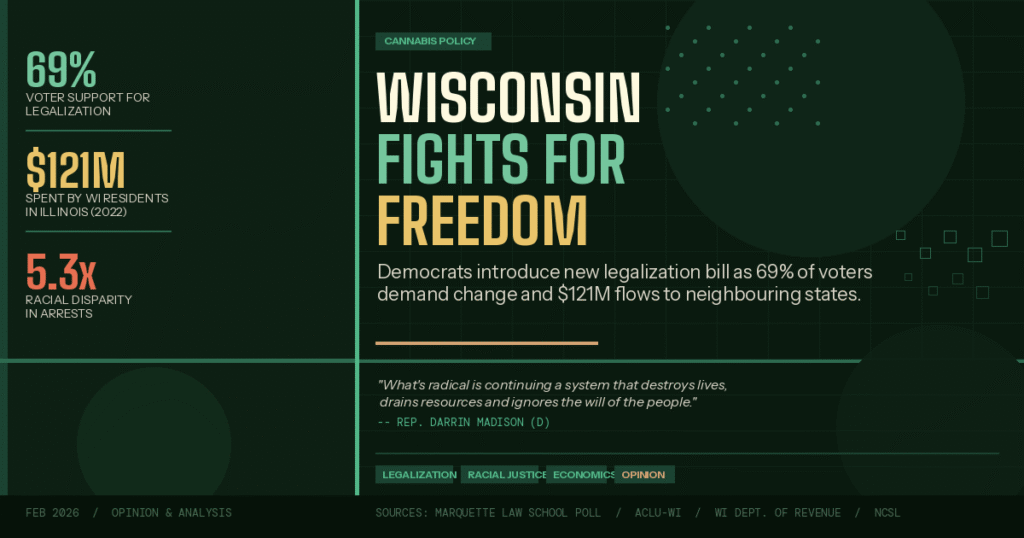
“Legalization of cannabis is not radical. What’s radical is continuing a system that destroys lives, drains resources and ignores the will of the people,” Madison said. “Wisconsin’s ready.”
He’s not wrong. A majority of states, including nearly every state that shares a border with Wisconsin, have already legalized marijuana in some form. According to the National Conference of State Legislatures, 40 states now have legal medicinal marijuana programs, and 24 states plus Washington D.C. allow recreational adult use. Illinois, Michigan, and Minnesota all have fully operational adult-use markets. Wisconsin? Still treating cannabis like it’s 1985.
“Wisconsin hasn’t [legalized], which leaves us behind the curve,” Madison explained. “Not because the evidence isn’t clear, not because people don’t support it, but because politics keeps on blocking progress.”
That last part stings a bit because it’s so obviously true. This isn’t a case where the public is divided or the evidence is murky. The data is clear, the public support is overwhelming, and Wisconsin is quite literally watching its residents drive across state lines to spend their money in states that figured this out years ago. A legislative analysis found that Wisconsin residents spent more than $121 million on cannabis in Illinois alone in 2022, handing their neighbour roughly $36 million in tax revenue. That’s Wisconsin money, going to Illinois. Let that sink in for a moment.
Madison also raised an interesting point about timing. President Donald Trump signed large-scale legislation that included provisions banning most consumable hemp products. That means the thriving hemp-derived THC industry in Wisconsin, which according to lawmakers has created around 3,500 jobs and contributed $700 million to the state’s economy, is now facing an existential crisis. Legalization at the state level could provide these businesses with a legitimate path forward, allowing them to transition from hemp-derived THC to cannabis-derived THC and keep jobs, investments, and innovation within the state’s borders.
“Legalizing cannabis is about replacing a failed punishment model with smart, evidence-based regulation,” Madison said. “People already use cannabis. Regulation ensures products are tested, labelled and safe, especially at a time when unregulated substances and opioids continue to claim lives across Wisconsin.”
This is a point that doesn’t get enough attention. People are already using cannabis. They’re just doing it without any consumer protections, quality testing, or safety standards. That’s not a policy win for anyone, regardless of your political persuasion.
Freedom: Not Just a Bumper Sticker
Rep. Andrew Hysell (D) took the microphone next, and he distilled the entire debate down to something beautifully simple.
“If I’m going to boil down what marijuana legalization is really about, it’s super simple: Legalization is about freedom, the freedom of adults to make up their own mind and to make their own choice whether to consume cannabis,” he said.
Now, I know the word “freedom” gets thrown around a lot in American politics, often to the point where it loses all meaning. But Hysell isn’t being hyperbolic here. Wisconsin is genuinely one of only a handful of states that completely bans the marijuana plant. In a country that prides itself on personal liberty, that’s a hard position to defend, especially when the evidence overwhelmingly suggests that cannabis is less harmful than alcohol, which you can buy at basically every petrol station and corner shop in the state.
“Standing in the way of the people’s freedom is not good politics. Almost 70 percent of Wisconsinites want full adult use legalization, and even more want medical,” Hysell added.
That 70 percent figure isn’t pulled from thin air. The Marquette Law School Poll, which is widely considered the gold standard of Wisconsin polling, has been tracking public opinion on cannabis legalization since 2013. Their June 2024 survey found that 67 percent of registered voters now support legalization, a 17-point increase from when they first started asking the question. A more recent December 2025 poll pushed that number even higher, to 69 percent.
Democrats back it at 88 percent. Independents at 79 percent. And here’s the kicker: even among Republicans, support for medical marijuana sits at around 78 percent, according to a January 2024 Marquette poll. When you’ve got nearly eight in ten members of the opposing party agreeing with you on a policy, and the legislature still won’t move? That tells you everything you need to know about the gap between the people and their elected officials.
What’s Actually in the Bill?
According to a legislative analysis shared with Marijuana Moment, here’s what the bill would do:
Adults 21 and older would be able to purchase and possess marijuana and hemp THC products. Hemp would be defined as a cannabis product containing up to 10 milligrams of an intoxicating cannabinoid such as delta-9 THC per 12 fluid ounces, per serving, or per package of an edible. Anything with higher concentrations would be classified as marijuana.
The possession limits are reasonable and well-structured: up to 2.5 ounces of flower in public, up to five pounds in a private residence (which is admittedly a lot of weed, but who am I to judge your weekend plans), up to one gram of THC in a cannabis-infused product, and up to 15 grams of cannabis concentrate.
A new “Division of Cannabis Regulation” would be established within the state Department of Agriculture, Trade and Consumer Protection to oversee production, processing, transportation, and testing. Retail dispensary licences would be issued through the state Department of Revenue.
The bill also creates a medical marijuana programme. People 18 and older (or younger with parental consent) could register as patients if they have qualifying conditions, which include cancer, glaucoma, AIDS/HIV, Crohn’s disease, Alzheimer’s, ALS, PTSD, opioid use disorder, and other conditions that the Department of Health Services could designate by rule. This is a comprehensive and compassionate list, and it’s worth noting that many of these conditions are ones where conventional pharmaceuticals either fall short or come with brutal side effects.
The tax structure is layered but not outrageous: a 10 percent excise tax for producers, 10 percent for processors, 5 percent for retailers on adult-use sales, a 10 percent occupational tax for cannabis microbusinesses, an optional 5 percent local excise tax, and a 3 percent excise tax for buyers (waived for registered medical patients). Revenue from that 3 percent consumer tax would go to the Department of Health to fund research into the health effects of cannabis use. That’s actually a smart move because it puts money directly into understanding what we’re legalizing, rather than just hoping for the best.
The bill also includes criminal justice reform provisions, creating a process to review convictions for acts that would be decriminalized under the new law. If someone is currently serving a sentence or on probation for such a conviction, they could petition a court to vacate the conviction and expunge the record, or adjust the conviction to a lower crime. This isn’t just window dressing. This is about recognising that thousands of people, disproportionately people of colour, have had their lives upended for something that the state would now be regulating and taxing.
And there are employment protections too. People who use marijuana in compliance with the law while off the clock would be protected from workplace discrimination. Because honestly, if your employer doesn’t care that you had three pints at the pub on Friday night, they shouldn’t care that you had a cannabis gummy either.
The Racial Justice Elephant in the Room
Let’s talk about something that makes a lot of people uncomfortable but is absolutely central to this conversation: the staggering racial disparities in marijuana enforcement in Wisconsin.
According to the ACLU of Wisconsin’s 2025 report “The State of Cannabis in Wisconsin”, Black people in Wisconsin were 5.29 times more likely than white people to be arrested for marijuana possession in 2022, despite comparable usage rates across racial groups. That’s not a typo. Five point two nine times more likely. For doing the exact same thing.
In 2022, there were more than 13,400 arrests in Wisconsin for cannabis offences, and the overwhelming majority were for simple possession. Not dealing, not trafficking, not running some kind of criminal enterprise. Just having weed on you.
And this isn’t getting better. An earlier ACLU report from 2020 found the disparity was 4.2 times. So in the space of just a few years, the gap actually got worse. In some Wisconsin counties, the numbers are genuinely jaw-dropping. In Ozaukee County, Black people were 34.9 times more likely to be arrested for marijuana possession. That’s not a statistic. That’s a scandal.
When Madison called legalization “a racial justice imperative,” he wasn’t exaggerating. He was understating it. The war on drugs has been, by virtually every measurable metric, a war on Black communities, and Wisconsin’s enforcement patterns are among the most egregious examples in the entire country.
The Republican Roadblock (and Some Cracks in the Wall)
Here’s where things get politically interesting, and more than a little frustrating.
Assembly Speaker Robin Vos (R) has been the primary obstacle to cannabis reform in Wisconsin for years. He recently said that Trump made the “wrong” choice to order the rescheduling of marijuana, calling it a “dangerous drug.” However, and this is important, he did acknowledge that research barriers being lifted could demonstrate that medical cannabis can be used effectively as an alternative to prescription medications. That’s not nothing. It’s not legalization, but it’s an acknowledgment that the conversation is shifting beneath his feet.
More encouraging is what’s happening in the Senate. Senate President Mary Felzkowski (R) and Sen. Patrick Testin (R) filed a Republican-led bill to legalize medical marijuana, and the Senate Health Committee debated the proposal at a hearing. The chair said the panel would be advancing it “fairly quickly.” Felzkowski has been a consistent advocate for medical cannabis across multiple legislative sessions, and the fact that she’s a Republican pushing this forward speaks volumes about where the political winds are actually blowing.
But here’s the rub: Vos has already said the Senate bill is “unlikely” to pass the Assembly because it’s “way too broad and way too wide-ranging.” So we have one chamber of the legislature actively working on cannabis reform, and the other chamber’s leader essentially saying “not on my watch.” It’s like watching two people try to drive the same car in opposite directions.
Assembly Majority Leader Tyler August (R) has been slightly more pragmatic. “I don’t think anyone is naive enough to think that marijuana and THC products aren’t present in the state of Wisconsin when they are readily available over state lines, so I think we need to come to an answer on this,” he said. “I’m hopeful that we can.”
That’s the kind of quote that gives you a tiny flicker of hope. It’s not a ringing endorsement, but it’s an acknowledgment of reality, and in politics, sometimes that’s where change starts.
Sen. Dan Feyen (R), the assistant majority leader, put it this way: “If we’re going to call it medical marijuana, it needs to be treated like a pharmaceutical. But the marijuana debate is going to be something that is not going to go away. The margins are tighter.”
He’s right. The margins are tighter. And they’re going to keep getting tighter as public opinion continues to shift, as more states legalise, and as the economic argument becomes increasingly impossible to ignore.
The Governor’s Race and the Path Forward
With just under a year before voters elect their next governor, the marijuana issue is shaping up to be a significant campaign topic. The majority of current candidates have indicated they would support efforts to legalize marijuana, and several have explicitly linked legalisation to funding public programmes like broadband access.
Current Gov. Tony Evers (D), who supports legalisation, isn’t seeking re-election. But he’s spent his entire tenure pushing for reform. He’s included marijuana legalization in multiple budget proposals (all of which Republicans have stripped out), signed an executive order to convene a special legislative session on citizen ballot initiatives, and consistently argued that Wisconsin residents shouldn’t have to drive to Illinois to access a legal market.
“We’ve been working hard over the last five years, several budgets, to make that happen,” Evers said. “I know we’re surrounded by states with recreational marijuana, and we’re going to continue to do it.”
The Wisconsin Department of Revenue released a fiscal estimate in 2023 projecting that legalization could generate nearly $170 million annually in tax revenue. The Wisconsin Legislative Fiscal Bureau separately estimated $165.8 million per year under Evers’s proposed recreational programme. For a state that was sitting on a budget surplus and still debating how to fund infrastructure improvements, that’s a serious chunk of change being left on the table.
The Bigger Picture: What This Really Comes Down To
Here’s my honest take on all of this.
The arguments against marijuana legalization in Wisconsin in 2026 are running on fumes. The public supports it. The economic case is rock solid. The racial justice implications of continued prohibition are morally indefensible. The neighbouring states have legalised and haven’t descended into chaos. The medical evidence supports at minimum a robust medical programme.
What’s standing in the way isn’t evidence, public opinion, or even political ideology. It’s institutional inertia and a handful of lawmakers who’ve decided that their personal views should override the clearly expressed will of their constituents. And that’s not governance. That’s obstruction.
The good news? This debate genuinely isn’t going away. Every year, the polling numbers tick up. Every year, more states legalise. Every year, more tax revenue flows across Wisconsin’s borders to states that got there first. Eventually, the dam will break. The only question is how much longer Wisconsin residents will have to wait, and how many more lives will be disrupted by marijuana arrests in the meantime.
Whether you’re for or against recreational use, the medical case alone should be a no-brainer. People suffering from cancer, PTSD, chronic pain, and opioid addiction deserve access to a treatment option that their neighbours in Illinois, Michigan, and Minnesota already have. Denying them that access because of political stubbornness isn’t conservative governance. It’s just cruelty with extra steps.
Wisconsin, you’re better than this. And I think most of you already know it.
Key Resources and References
Here are some government and institutional sources for further reading:
- National Conference of State Legislatures: State Medical Cannabis Laws – Comprehensive overview of cannabis legislation across all 50 states
- NCSL Cannabis Overview – National landscape on legalization and decriminalization
- Wisconsin Department of Revenue – State agency responsible for dispensary licensing under the proposed bill
- Wisconsin Department of Agriculture, Trade and Consumer Protection – Would house the proposed Division of Cannabis Regulation
- Marquette Law School Poll – Wisconsin’s most comprehensive statewide polling project, tracking cannabis support since 2013
- ACLU of Wisconsin: The State of Cannabis in Wisconsin – Detailed report on racial disparities in marijuana enforcement and the cost of criminalization
- ACLU: A Tale of Two Countries – National report on racially targeted marijuana arrests
- NORML: Racial Disparity in Marijuana Arrests – Fact sheet covering arrest disparities including Wisconsin-specific data
- Wisconsin Legislature – Official legislative documents and bill tracking
- Marijuana Policy Project: State Laws Map – Interactive map of marijuana laws by state
The views expressed in this article represent personal opinion based on publicly available data and government sources. This article is not legal advice and should not be treated as such. All polling data, arrest statistics, and fiscal projections are sourced from the institutions cited above. Readers are encouraged to review the primary sources and form their own conclusions.
Related reading: How to read cannabis terpene profiles | Where to buy premium cannabis terpenes | Cannabis terpene education resources