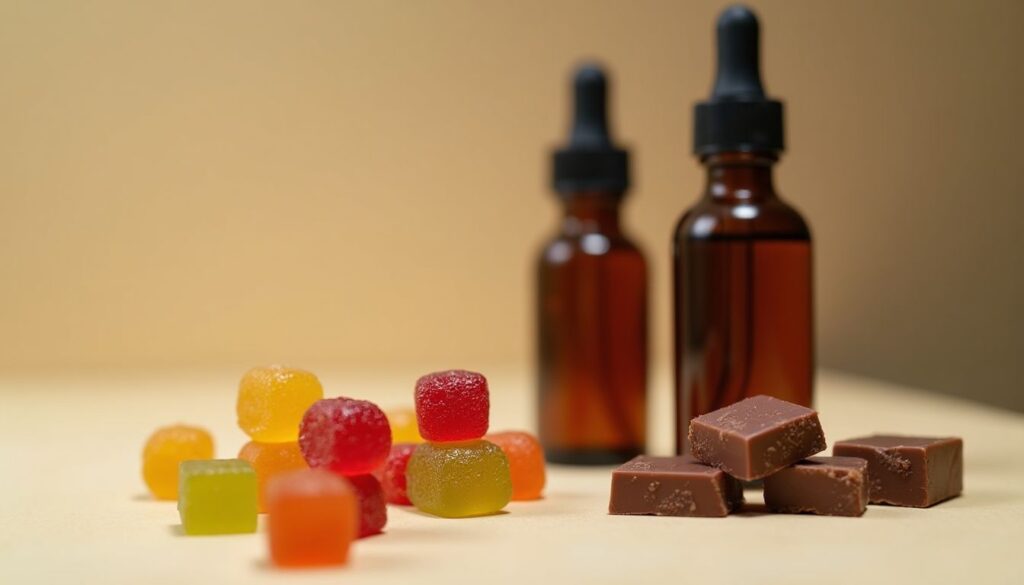

Terpenes behave differently in an edible than they do in a vape or a topical. You’re not working with a clean canvas. You’re dropping aromatic compounds into a matrix full of sugar, fat, acids, and competing flavors, then often heating the whole thing and asking it to stay consistent for months on a shelf. That’s a lot to ask of a molecule that evaporates if you look at it wrong.
If you formulate gummies, chocolates, or beverages, choosing the right terpene blend is less about picking a nice smell and more about survival. Will the profile still taste right after production? Will it dose evenly? Will it hold up in an oxidizing, fat-heavy base? This guide walks through what actually matters when you’re building an edible around terpenes, from taste and stability to effect positioning and testing before you scale.
Why terpenes are harder to work with in edibles
Terpenes are volatile by nature. Many of them start evaporating at temperatures well below what you’d use to cook a gummy slurry or temper chocolate. So the first challenge is heat. If you add your blend early in a hot process, a good chunk of the aroma can simply leave before the product ever hits a mold.
Then there’s the food itself. An edible already tastes like something, usually sweet, fruity, or rich. Your terpenes have to coexist with that, not fight it. A dose of myrcene that smells earthy and clove-like can turn a bright citrus gummy slightly musty if you’re not careful with the ratio.
Fat and oil interactions add another layer. Terpenes are lipophilic, meaning they love fat. In a chocolate or a gummy with an oil-based cannabinoid emulsion, terpenes will partition into the fat phase and can mute their own aroma or migrate unevenly. And because they’re reactive, they oxidize over time, which shifts flavor and can degrade the profile you paid for. Dosing precision matters too, because you’re often adding fractions of a percent by weight and expecting every piece to taste identical.
Taste and mouthfeel: getting the sensory part right
Start with the flavor logic, not the terpene list. Ask what the finished product should taste like, then work backward to a blend that supports it rather than overwrites it.
A few principles that tend to hold up across formats:
- Less is usually more. Terpene inclusion rates in finished edibles are typically very small, often well under one percent by weight, and frequently far lower. Overdosing reads as soapy, medicinal, or harsh on the back of the throat.
- Bitterness and burn are real. Some terpenes carry a peppery or astringent edge at higher concentrations. In a delicate beverage, that shows up fast.
- Mouthfeel shifts with oil load. Adding terpenes in an oil carrier can subtly change texture in a gummy or leave a coating sensation in a drink. Test the full sensory experience, not just the smell off a spoon.
The goal is a profile that feels intentional. If a taster can’t tell whether the flavor is “supposed” to be there, the blend is either dialed in nicely or too quiet to matter. You want the former.
Stability: keeping the profile alive on the shelf
What makes a terpene blend unstable in an edible? Three things, mostly: heat during production, oxidation over time, and reactive ingredients in the base like acids or metals. Any of these can flatten or distort a profile before the customer opens the package.
Heat is the one you control most directly. Where possible, add terpenes late in the process, after the hottest steps, and at the lowest temperature the format allows. Cooling a gummy slurry slightly before dosing can preserve noticeably more aroma than adding at a rolling temperature.
Oxidation is slower but relentless. Terpenes react with oxygen, and that reaction speeds up with light, heat, and time. A few practical moves that often help:
- Minimize headspace oxygen in storage and packaging where you can.
- Keep bulk terpenes cool and sealed, away from light, before you use them.
- Consider food-safe antioxidants already common in your base, since some formulations pair terpenes with protective ingredients to slow degradation.
- Encapsulate or emulsify when the format allows, which can shield volatile compounds from the surrounding matrix.
Masking is a legitimate strategy too. In products where a slightly “green” or herbal note is undesirable, a well-built flavor system can carry the effect-relevant terpenes while food flavors sit on top. The terpenes still do their job; they just aren’t the loudest voice in the room.
Matching terpene profiles to effect positioning
Most edible brands sell an experience, not a molecule. “Wind down,” “focus,” “social,” “sleep.” Terpenes are commonly associated with these positioning angles, and choosing a blend that aligns with your marketing story keeps the product coherent from flavor to feel.
A few terpenes come up again and again in this context. Myrcene is often linked to relaxing, heavier positioning. Limonene tends to sit in bright, uplifting, mood-forward products. Linalool, the floral note also found in lavender, is frequently associated with calm. Pinene shows up in alert, clear-headed framing, and caryophyllene gets used in warm, spicy, grounding profiles.
These associations are cultural and traditional as much as anything, and individual response varies, so it’s worth framing them honestly in your product story. What you can control precisely is consistency: pick a profile, define it, and reproduce it batch after batch so your “relaxing” gummy actually tastes and reads the same every time.
Flavor pairing by edible format
The right blend depends heavily on the base. A terpene that shines in a tart gummy can get lost in chocolate or turn muddy in a carbonated drink. Here’s a starting-point reference for matching common terpenes to formats and positioning. Treat it as a jumping-off point for your own bench work, not a rulebook.
| Positioning | Common terpenes | Best-fit format | Flavor notes to build around |
|---|---|---|---|
| Relaxing / evening | Myrcene, linalool | Chocolate, soft chews | Berry, stone fruit, cocoa, vanilla |
| Uplifting / daytime | Limonene, terpinolene | Gummies, sparkling beverages | Citrus, tropical, bright and tart |
| Focus / clear-headed | Pinene, limonene | Beverages, hard candy | Herbal citrus, green apple, mint |
| Social / balanced | Caryophyllene, limonene | Gummies, chocolate | Spiced orange, warm berry, ginger |
| Sleep / deep calm | Linalool, myrcene | Soft chews, warm drinks | Lavender-honey, chamomile, vanilla |
Gummies are the most forgiving format because tart and fruity flavors mask herbal notes well. Chocolate is trickier, since fat pulls terpenes into the lipid phase and cocoa is aromatic on its own, so lean toward warm, rich pairings. Beverages are the most demanding of all: low fat, high water, often carbonated and acidic, which exposes off-notes instantly and makes solubility and even dispersion a real engineering problem. If you’re building drinks, plan on more testing, not less.
Dosing and evenness across a batch
An uneven terpene blend is a quality problem hiding as a flavor problem. If piece one tastes like citrus and piece twelve tastes flat, you don’t have a recipe, you have a lottery.
Evenness starts with dispersion. Because terpenes love fat and hate water, they won’t distribute themselves through a base on their own. You typically need a carrier oil, an emulsifier, or a pre-blend that lets the terpenes spread uniformly before the mix sets. Adding a concentrated blend directly into a large slurry without proper mixing is a reliable way to get hot spots and dead zones.
Keep these dosing habits in mind:
- Pre-dilute concentrated blends into a compatible carrier so tiny amounts disperse predictably.
- Standardize your addition point in the process so every batch behaves the same way.
- Mix thoroughly but not endlessly, since over-processing at heat can drive off the very aroma you’re trying to distribute.
- Weigh, don’t eyeball. At fractions of a percent, small measurement errors become large flavor swings.
This is exactly where working with a formulation partner who understands terpene formulation for edibles can save weeks of trial and error, because the dispersion and dosing questions are solved problems if you have the right inputs.
Sourcing and what to actually sample
Terpene quality varies wildly between suppliers, and in an edible you’re eating the result, so purity and documentation aren’t optional. Before you commit to a blend, get answers on a few basics.
What to ask for and check:
- Analytical proof. Ask for GC-MS data so you know the actual composition, not just a marketing name. A profile is only as good as its documentation.
- Food-grade and manufacturing standards. Look for suppliers working under cGMP-style quality controls, since this is going into food.
- Botanical vs cannabis-derived. Both exist; know which you’re buying and whether it fits your product story and compliance needs.
- Consistency between lots. A blend that drifts batch to batch will wreck your reproducibility downstream.
Then sample properly. Don’t judge a blend by sniffing the bottle. Order small quantities and build them into a real version of your edible, because the base changes everything. Ordering sample packs to test in your edible is far smarter than committing to bulk on the strength of an aroma alone. Companies like Entour, founded on the work of Dr. Jeffrey Raber and True To Plant, pair GC-MS analysis with cGMP manufacturing precisely so formulators can trust what’s in the bottle.
How to test a profile before you scale
Bench testing an edible terpene blend is where most avoidable failures get caught. Run it like a small experiment, not a taste test.
A simple, repeatable process:
- Make a small control batch of your base with no terpenes as your reference point.
- Prepare two or three low-inclusion versions of the blend at different rates, keeping everything else identical.
- Taste fresh, then again after 24 to 48 hours, since flavor shifts as the product settles.
- Stress the samples: hold some warm, some in light, some sealed, to preview shelf behavior.
- Check evenness by tasting multiple pieces from the same batch, not just one.
- Only then scale the winning inclusion rate, and re-verify at production volume.
The gap between a bench sample and a full production run is where profiles fall apart, so never assume a good small batch means a good big one. Confirm at scale before it hits a label.
Bringing it together
Choosing a terpene blend for edibles is a balancing act between taste, stability, effect positioning, and manufacturability. Get the inclusion rate low and intentional, protect the profile from heat and oxidation, match it to how you actually sell the product, and prove it out in your real base before you scale a single batch.
If you’re building an edible line and want terpene profiles that are documented, food-appropriate, and formulated for your specific base, it pays to start with samples and analytical data rather than guesswork. Test a few profiles in your own product, taste them across the shelf-life window, and build from there. That’s how a blend goes from a nice idea to a consistent, shippable product.