
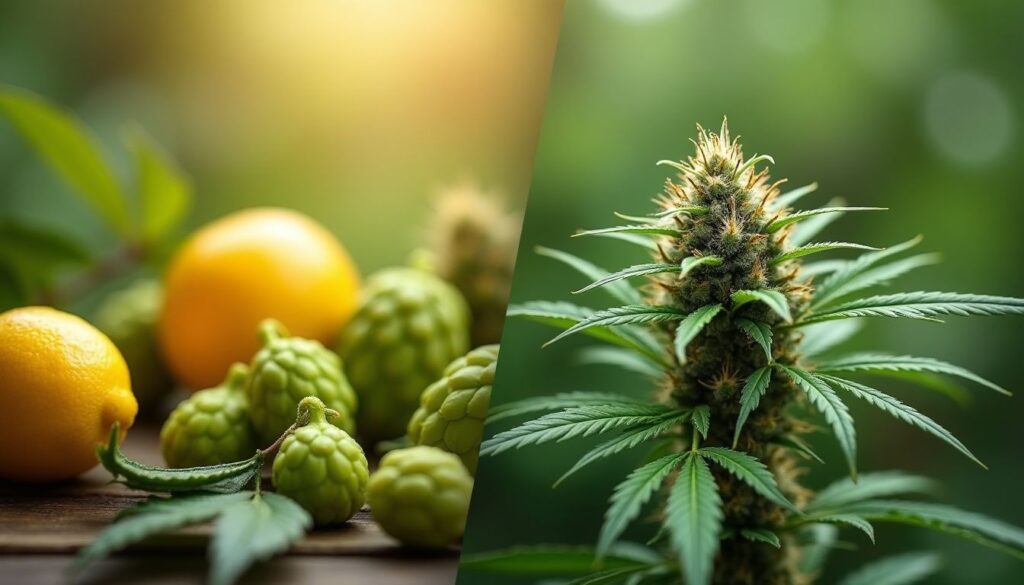

The first time you source terpenes, you’ll face a choice: botanical or cannabis-derived (CDT). And nobody explains the practical difference until you’re deep in conversations with suppliers.
Here’s what actually matters: cost, legality, consumer perception, quality, and sourcing complexity. This guide covers all five so you can decide what’s right for your brand.
What’s the Actual Difference?
Botanical terpenes are extracted or synthesized from plants like pine, lemon, hops, and lavender. They’re chemically identical to what’s in cannabis, but sourced from plants that are easier to cultivate and extract from at scale.
Cannabis-derived terpenes (CDT) are extracted directly from cannabis flower or trim. They carry the full terpene profile of a specific cultivar (strain).
That’s it. Chemically, myrcene from a lemon is identical to myrcene from cannabis. But the sourcing, legality, and perception are very different.
Cost Comparison
| Expense | Botanical | Cannabis-Derived |
|---|---|---|
| Sample (10ml) | $50-100 | $150-300 |
| Scaling (500ml) | $4-6/ml | $8-15/ml |
| Enterprise (2L+) | $2-4/ml | $6-12/ml |
| Custom formulation | $300-800 | $1,000-2,500 |
Botanical is cheaper. If cost is your primary constraint, botanical wins.
Legality
Botanical terpenes: Legal in all 50 US states, most countries. They’re food-grade, sold as flavoring ingredients, zero regulatory friction. If your brand operates in a state where cannabis is illegal, botanical is your only option.
Cannabis-derived terpenes: Legal only in states where cannabis is legal. Federal terpene extraction from cannabis is prohibited (DEA Schedule I). Even in legal states, some state regulators require proof that the CDT source was from legal cannabis.
If you’re selling in multiple states (some legal, some not), botanical is safer. You can use the same terpenes everywhere. If you’re selling only in legal states and want authenticity, CDT is viable but requires state-compliant sourcing.
Red flag: Any supplier claiming CDT is legal everywhere is either not telling the full story or misunderstanding the regulations.
Consumer Perception
Botanical positioning: “Inspired by cannabis strains but formulated with botanical terpenes.” This is honest and opens you to broader markets. Cannabis-curious consumers in non-legal states can try your products.
CDT positioning: “Real cannabis terpene profiles, extracted from premium cultivars.” This signals authenticity to cannabis-forward consumers. In legal markets, it’s a premium positioning.
Both are legitimate. But the market is different.
Botanical appeals to: wellness brands, novelty markets, interstate shipping, cannabis-curious consumers. CDT appeals to: cannabis connoisseurs, legal-market brands, premium positioning.
Botanical is broader market access. CDT is narrower but higher perceived value.
Quality & Authenticity
Botanical terpenes: You can get high-quality botanical terpenes. GC-MS verified, consistent, stable. The downside: they’re blended to approximate cannabis strains, not recreate them exactly. A botanical “OG Kush” is close, not identical.
Cannabis-derived terpenes: These are the real deal. You’re getting the actual terpene fingerprint of the cultivar. If you extract from OG Kush flower, you get OG Kush terpenes. But extraction quality varies. Some CDT is over-processed, loses volatiles, tastes off.
The best cannabis-derived terpenes are extracted carefully (not over-heated), stored properly, and verified by GC-MS. Cheaply-made CDT can smell dusty or off because extraction wasn’t controlled.
Quality matters more than botanical vs CDT. A good botanical profile beats bad CDT. Insist on GC-MS verification for either.
Sourcing Complexity
Botanical terpenes: Industrial supply chains (multiple suppliers available). Fast lead times (5-7 days for samples, 7-14 days for scaling). Standardized profiles (formulae are documented, repeatable). Easy to source at any scale.
Cannabis-derived terpenes: Limited suppliers (only those licensed in cannabis states). Longer lead times (7-14 days for samples, 14-21 days for scaling). Cultivar-dependent (quality depends on source material, harvest timing, extraction method). Harder to source for consistent production (plant variability affects profiles).
If consistency is critical (you’re scaling to 100+ SKUs or need batch-to-batch precision), botanical is simpler. If authenticity is critical (you’re positioning on “real cannabis genetics”), CDT is worth the complexity.
Strategic Decision Matrix
Choose Botanical if: You’re price-sensitive. You want to operate across multiple states (including non-legal). You’re positioning on wellness or novelty. You need consistent, repeatable batches. You’re new to sourcing and want simplicity.
Choose Cannabis-Derived if: You’re operating only in legal states. You’re positioning on premium authenticity. You have margins to support higher costs. Consumer taste/authenticity is your key differentiator. You’re targeting cannabis connoisseurs specifically.
Choose a Blend (Botanical + CDT) if: You want two SKU lines: affordable botanical, premium CDT. You can segment by positioning. You’re entering legal and non-legal markets simultaneously. You’re hedging against regulatory changes.
Making Your Choice
Before you commit to botanical or CDT:
- Define your positioning: Are you cannabis-authentic or wellness-inspired?
- Check legality: Where are you selling? All legal states, mixed, or non-legal only?
- Calculate margin: What’s your price point? Does it support CDT cost?
- Plan for growth: If you expand to non-legal states, can you switch to botanical mid-launch?
- Test both: Sample botanical and CDT profiles. Let your team taste the difference.
Most successful brands start with botanical (lower risk, lower cost), then add a CDT line once they prove product-market fit.
You don’t have to choose one forever. Many brands run both.